 |
 |
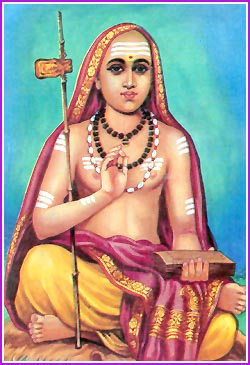
Shankaracharya |
||
 |
||
| Acharya means
teacher in Sanskrit. But in the religious history of Bharat, there has
been a tradition of special acharyas. They were not ordinary school teachers.
They were great philosophers too. To become such a philosopher one had
to write a thesis, more commonly known as a “commentary” on
three of Sanatan Dharma’s most important shastras. These are the
Brahma Sutras, the Upanishads and the Bhagvad Gita. They were originally
written by Bhagwan Ved Vyas - the first acharya of Sanatan Dharma. The
three shastras together, are known as Prasthantrayi. Therefore only a
super Sanskrit scholar, who was also a philosopher, could successfully
write a commentary on the Prasthantrayi. By writing this he would provide
a new interpretation. Only then would other scholars regard him as an
Acharya.
Sankaracharya was the first to write a commentary and he gave to the world his Advait philosophy. He established a tradition of Shankaracharyas which have successfully continued for the past 1200 years! Since he was the first Shankaracharya, he is also known as Adi Shankar. Before his birth, his childless parents, Shivaguru and Aryamba had prayed to Shivji in a mandir in Tiruchhur. By Shivji’s blessings he was born on Vaishakh sud 5,788 CE in Kaladi, a village in Kerala. Born by Shivji’s grace, the parents named the boy Shankar. Shankar was extremely intelligent from childhood. Incredibly, at two he studied the Purans. In Sanskrit ! By the age of eight he had studied the Vedas and other shastras! Shankar’s study of the shastras gave him wisdom that married life would be miserable. It would not help him progress fast on his path to moksh. Nor would it help in his teaching philosophy to others. When Aryamba came to know of this, she decided to get him married before he became an ascetic But Shankar was not interested. Instead he asked for her permission to become an ascetic. She refused because there was nobody else to look after her as she grew old. Shankar politely respected and accepted her decision. It would be sinful to hurt one’s parents. One day both of them went to bathe in the nearby Churna river. Suddenly a crocodile grabbed little Shankar’s leg. The crocodile slowly began to drag him into the water. Aryamba cried for help. But there was nobody else there. Shankar remained calm and prayed. He was up to his neck in the water. Bhagwan then inspired him with an idea. So he shouted to his mother : “If you give me permission to become a sadhu, the crocodile will let me go.” Poor Aryamba. But being a loving mother she granted him permission. At least then he would remain alive. Instantly the crocodile opened its mouth. Shankar was free. Not harmed a bit, he swam to the shore. After obtaining his mother’s blessings he left home in search of a true guru. On the banks of the river Narmada he met Govindpad. The sage asked him, “Who are you?” Govindpad happily accepted Shankar as his pupil. After teaching him knowledge and wisdom, Govindpad sent Shankar to Kashi, the greatest centre of knowledge in Bharat. It was here that Shankar wrote his commentaries on the Prasthantrayi, at the age of only sixteen! A world record! From then onwards many learned scholars became his disciples. In another famous work, Gurvashtakam Stotras, he strongly declares that : health, wealth, women, fame, power, worldly objects, donations or even being sinless will be useless, zero, if one does not surrender to a God-realised Guru. Shankar lived only till the age of 32. Yet during this short period,
he travelled tirelessly throughout Bharat twice. He defeated false pandits
and priests, who misinterpreted the shastras. He defeated Buddhist and
Jain pandits who had nearly destroyed Sanatan Dharma’s purity
and beliefs. With his awesome wisdom, he outwitted false and misguided
people. He re-united and revived the people of Bharat. To solidify his
work, to make sure it survived a long period, he founded four centres
in the four corners of Bharat : Their tradition has continued for over 1200 years, without being affected by foreign invaders. Bhagwan Swaminarayan has summarised Shankaracharya’s philosophy in Vachanamrut Gadhada I-42. In this he also points out some of its limitations and misinterpretations by later followers. |
||
 |
 |
| | Satsang Stories | Hindu Stories | Moral Stories | |
| | Home | Story Time | |